- Bengali Food
- Guides
- Festivals
A Bengali Food Glossary: What's Actually on the Plate
Every dish Sanhoti has served at an event in Orange County, explained — from begun bhaja and dhokar dalna to shorshe ilish and mishti doi.
By Sanhoti · · 5 min read
If you have looked at one of our published menus and found yourself reading a list of words you cannot pronounce, this is for you. Everything below is something Sanhoti has actually cooked and served at an event in Orange County — no generic "top ten Bengali dishes" list, just what has genuinely come out of our kitchen.
Bengali food has a structure. A proper meal is served in a specific order, from bitter to sweet, and each course does a job. That is worth knowing before the dish names make sense.
The order of a Bengali meal
Traditionally you eat in courses, all served onto one plate with rice as the constant:
- Shukto — a mildly bitter vegetable dish. It opens the meal, which surprises people. The logic is that bitterness wakes up the palate.
- Dal with a fried thing — usually a bhaja.
- Vegetables — the torkari and dalna dishes.
- Fish — the heart of the meal for most Bengalis.
- Meat, if there is any. Mutton, usually.
- Chutney — sweet, not spicy. It signals the meal is ending.
- Mishti — sweets, and then mishti doi.
At a Sanhoti event you will get a compressed version of this, served buffet-style, but the order still shapes what is on offer.
Rice and breads
Sada Bhaat — plain white rice. The base of everything.
Khichudi (also written khichuri) — rice and lentils cooked together with ghee, turmeric and whole spices into something between a risotto and a stew. This is the definitive bhog dish: what is offered to the goddess at Durga Puja and then served to everyone. Comfort food with religious standing.
Luchi — a small, puffed, deep-fried white-flour bread. Not to be confused with a puri, which is made with wholewheat. Luchi is paler, softer, and the standard festival breakfast alongside a potato curry.
Kaju Kishmish Pulao — a mildly sweet pilaf with cashews and raisins. Bengali pulao leans sweeter than most Indian rice dishes, which catches people out pleasantly.
Naan and Butter Naan — the North Indian breads, included because our menus are not purist and plenty of attendees want them.
The fried things — bhaja
Bhaja simply means fried. These arrive early in the meal alongside dal, and they are how the meal gets its texture.
Alu Bhaja — potatoes cut into matchsticks and fried crisp.
Begun Bhaja — thick slices of aubergine, turmeric-rubbed and shallow-fried until they collapse. If you eat one thing from this list, this.
Beguni — the same aubergine, but in a chickpea-flour batter. Bhaja is naked; beguni is battered.
Maach Bhaja — fried fish, usually a firm river fish, rubbed with turmeric and salt and fried hard.
Papad Bhaja — fried papadum.
Veg Chop — a croquette of beetroot, carrot and peanut, breadcrumbed and fried. A Kolkata street-food staple, and the single most underrated thing on any of our menus.
Dal
Cholar Dal — split chickpea lentils cooked sweet, with coconut, raisins and whole spices. Eaten with luchi. Not a savoury dal in the way most people expect.
Daal Makhani — the North Indian black-lentil dish, slow-cooked with butter and cream.
Macher Matha Diye Dal — dal cooked with a fish head. It sounds confronting and tastes extraordinary; the head enriches the dal in a way nothing else does. A dish for people ready to go one step further.
Vegetables
Alur Dom — slow-cooked spiced potatoes, thick and dark. The partner to luchi.
Labra — a mixed vegetable dish with five or more vegetables cooked down together, seasoned with panch phoron. Served as bhog beside khichudi.
Dhokar Dalna — lentil cakes, fried and then simmered in gravy. One of the great vegetarian dishes of Bengal, and genuinely laborious to make.
Echor'er Torkari — green jackfruit cooked as a curry. Jackfruit is called gach patha — "tree mutton" — because the texture is so close to meat. Vegetarians who miss mutton should try this.
Alu Potol — potato and pointed gourd, made either plain vegetarian or Alu Potol Chingri, with small prawns.
Fish
Fish is the centre of Bengali cooking. Bengal is a delta; the food follows the rivers.
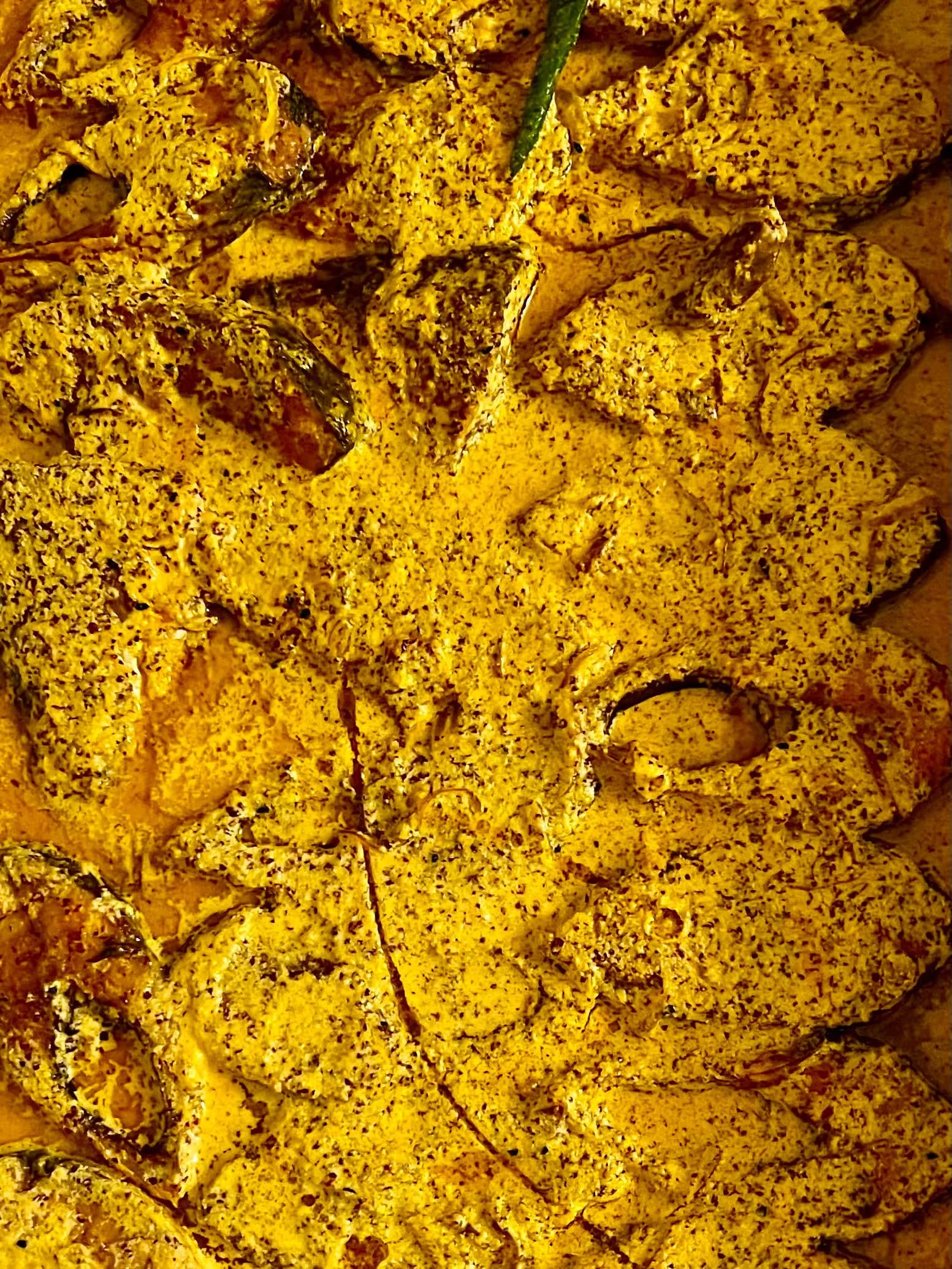
Shorshe Ilish — hilsa in mustard sauce. The most emotionally significant dish in the entire cuisine. Hilsa is bony, oily, intensely flavoured, and Bengalis will argue about it for hours. Sourcing it in California is an annual undertaking. You may see it spelled Sorse Ilish — same dish, different transliteration.
Chingri Malaikari — prawns in a coconut-milk gravy, mild and rich. The dish to order if you are unsure about Bengali fish; nothing about it is challenging.
Fish Amritsari — battered fried fish, Punjabi rather than Bengali, and popular enough that it stays on the menu.
Meat
Mutton Curry — goat, slow-cooked. Bengali "mutton" means goat, never lamb.
Goat Biriyani — Kolkata biriyani is distinct from Hyderabadi or Lucknowi: it contains a whole potato, and the potato is not a filler. It is the point, for many people. Ask a Bengali about the potato.
Chicken Rezala — chicken in a pale, fragrant yoghurt-and-cashew gravy with green chilli and mace. A Mughal-influenced Kolkata dish, and much subtler than it looks.
Methi Chicken — chicken with fenugreek leaves.
Sweets
Bengal's reputation rests here, and it is deserved. Bengali sweets are largely built on chhena — fresh curd cheese — which makes them lighter and less sugar-dominated than sweets elsewhere in India.
Sandesh — chhena worked with sugar and shaped. The most refined Bengali sweet, and the one that most rewards a good maker.
Ros Malai — flattened chhena discs in sweetened, cardamom-scented milk.
Malai Chomchom — an oval sweet in thickened cream.
Mishti Doi — sweet yoghurt, set in earthenware, caramel-brown. The proper end to a Bengali meal, and the thing to try if you try one sweet.
Malpoa — a fried pancake soaked in syrup.
Rabdi — milk reduced slowly until it thickens into something between a cream and a custard.
Jalebi — the orange spiral, which needs no introduction.
Chutney — and why it is sweet
Aam'er Chutney (green mango) and Tomato Chatni are sweet, sharp and eaten near the end of the meal with papad, not as a condiment alongside the main food. This trips up almost everyone the first time. It is a course, not a sauce.
Vegetarian and children
Every Sanhoti menu carries full vegetarian options, and bhog is always vegetarian and cooked without onion or garlic, because it is offered food. For children who are not yet adventurous there are usually nuggets, momos and pizza — no one is going home hungry on principle.
Come and eat
The full menu for each event goes up in advance on the Bengali food page and on the event page itself, so you can read it before you decide. If you have an allergy, tell us first and we will be honest about what a volunteer kitchen can and cannot promise.
You do not need to be Bengali, know any of these words, or have eaten Indian food before. Turn up hungry.
Come to the next one
Our next event is Srijan. Everything Sanhoti runs is open to the public — you do not need to be Bengali or a member.
Published by Sanhoti Bengali Association of Orange County, a 501(c)(3) non-profit. EIN 39-2903777.
Keep reading
More from Sanhoti
How a Durga Puja Gets Built in America
There is no pandal contractor in California. So the backdrop, the alpana, the lighting and the cultural programme are…
Your First Durga Puja: A Guide for People Who Have Never Been
What actually happens at a Durga Puja in Orange County, what to wear, what you will be fed, and why you do not need to…