
- Durga Puja
- Volunteering
- Festivals
- Orange County
How a Durga Puja Gets Built in America
There is no pandal contractor in California. So the backdrop, the alpana, the lighting and the cultural programme are made by engineers and nurses and teenagers in a garage — and the whole thing goes up, and comes down, in a weekend.
By Debasis Pramanik · · 5 min read
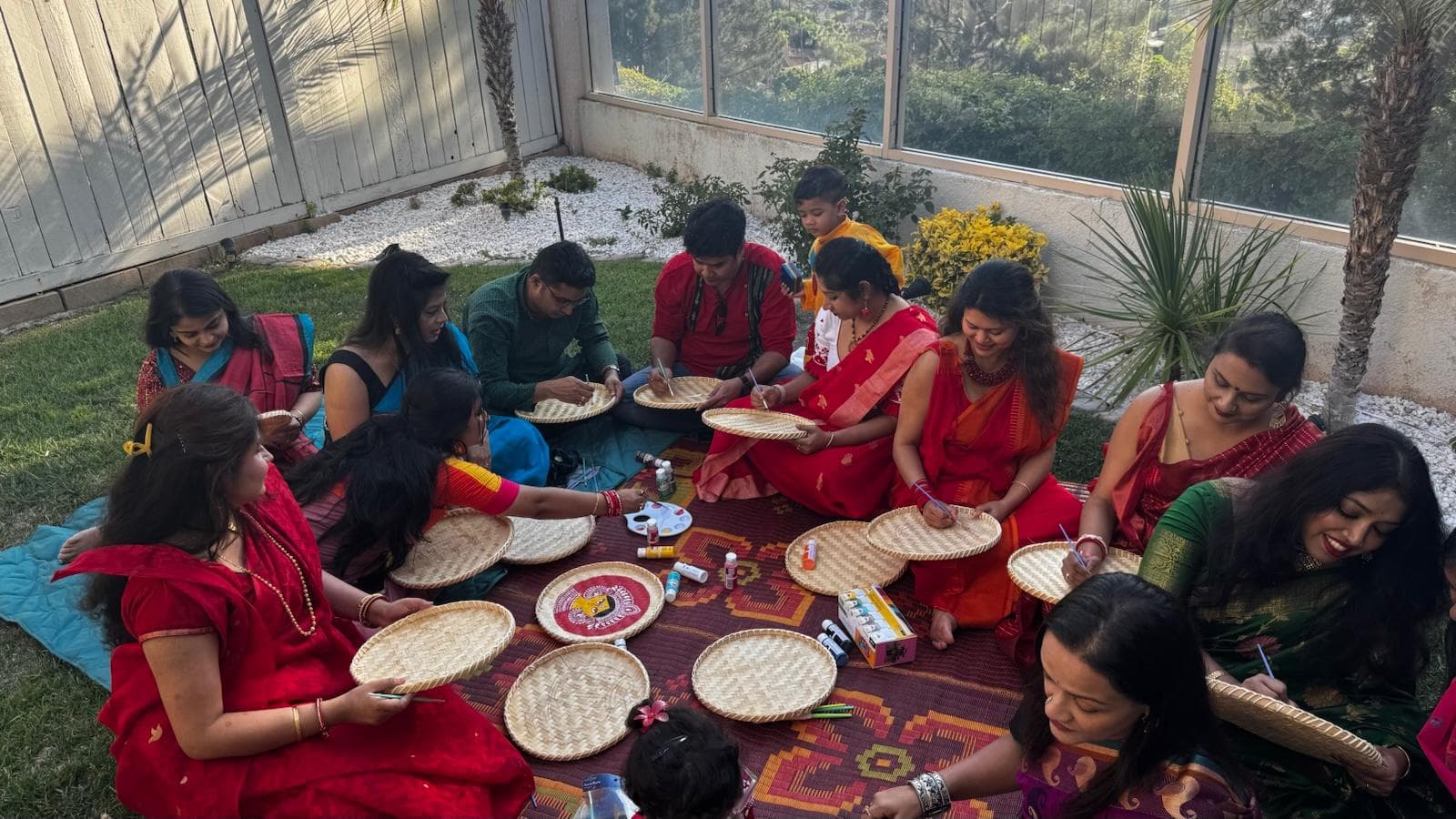
In Kolkata, a Durga Puja committee hires people. A firm builds the pandal. A workshop in Kumartuli delivers the idol. There is a lighting contractor, a decorator, a caterer, a sound company, and dhakis who turn up with their drums and know exactly where to stand. The committee raises the money and makes the decisions. Somebody else does the work.
None of that exists in Orange County.
There is no pandal contractor in California. There is no decorator who knows what a chalchitra is. Nobody within two thousand miles rents out alpana stencils. So when a few hundred of us gather in a college hall in Costa Mesa each October, everything you can see in that room was made, carried, assembled and paid for by people who have day jobs.
That turns out to be the most interesting thing about a Durga Puja in America, and it is the part visitors never see.
The venue gives you a room, not a week
This is the constraint everything else bends around.
In Bengal, a neighbourhood pandal goes up over weeks. The bamboo frame appears in September and the whole para watches it get skinned and painted and lit. It stands for a fortnight. Nobody is in a hurry.
We get a school hall. We get it on a Friday, and we have to hand it back on a Sunday night with the floor swept, because there is a basketball practice on Monday morning.
So a Durga Puja that takes three weeks to build in Kolkata gets built here in an afternoon. The idol comes out of storage. The backdrop goes up. The lighting rig, the sound desk, the mandap, the seating, the kitchen, the stall tables, the signage, the children's craft corner — all of it appears between the doors opening and the first arati. And then, roughly forty-eight hours later, all of it disappears again.
The wrap-up is the same problem in reverse and it happens at midnight, when everyone is tired and full and would rather be anywhere else. That part never makes it into a photograph.
Which means we start in someone's garage
Because the hall is only ours for a weekend, everything that can be made in advance, is.
Through late summer the work moves into garages and living rooms across the county. Somebody's dining table is lost to papier-mâché for a month. Backdrops get painted in panels sized to fit in the back of an SUV. The alpana is worked out on paper first, because you cannot practise on a floor you do not have. Fabric is cut, frames are built, and a surprising amount of it hinges on whether a piece will survive a freeway at sixty-five miles an hour.
None of these people are professional artists. They are engineers and nurses and accountants and a lot of teenagers who were volunteered by their parents and then stayed because it turned out to be fun.
And that is the honest reason we do it this way, rather than writing a cheque to make the problem go away. The building is the festival. The weekend is four days long; the making goes on for two months. More people know each other because of a Saturday afternoon spent cutting shola than because of anything that happens at the puja itself.
The same is true of the cultural programme. The dance items, the recitations, the children's skit, the choir — rehearsed in a garage, in a park, over video call when nobody can drive. Nobody is auditioning anyone. If your daughter wants to dance, your daughter dances.
Then the actual puja, which is not negotiable
For all the improvising around it, the rituals themselves are done properly.
A priest conducts them in Sanskrit. Anjali happens standing, in bare feet, on Ashtami — the flower offering, everyone repeating lines most of us do not fully understand and say anyway. There is bhog, cooked in vats by volunteers who started at six in the morning: khichudi, labra, a fried thing, payesh or mishti doi at the end. On Dashami the married women do sindoor khela and end up red-faced and laughing, and somebody always cries.
Then everyone says Shubho Bijoya, eats a sweet, and starts taking the room apart.
The compression does not damage any of that. Bengal spreads five days over five days; we spread them over a weekend. The shape survives.
And then the bit that is purely American
Here is where a Durga Puja in the United States genuinely departs from one in Bengal: the concert.
Every large puja in America books artists from India, and it is a real draw — for many families it is the single thing they buy tickets for and plan the weekend around. In Kolkata you can hear these singers any month of the year. In Orange County you cannot, and that scarcity is what makes an evening in a college theatre feel like an event rather than a booking.
Sanhoti has brought over Mahalakshmi Iyer, whose voice you know from Dil Se and half the Yash Raj catalogue even if you have never learned her name, and Rathijit Bhattacharjee with Shreya M Bhattacharjee. For 2026 it is Subhadeep Das Chowdhury — Indian Idol runner-up, classically trained, Kolkata — on the Friday, and Akriti Kakar on the Saturday.
Worth being straight about the money, because people assume: the concerts are not funded out of donations. Artist fees and travel are paid for by ticket sales and by sponsors. Donations go to the charity work, which is a separate thing with a separate account and a separate purpose.
The bit between everything else
And in the gaps, adda.
There is no English word for it. "Chatting" is far too thin. Adda is unhurried, argumentative, aimless conversation among people who have nowhere better to be — about politics, about a film nobody else has seen, about whose luchi were better this year. It has no agenda and no end time. It is, for a lot of us, the actual point of the weekend.
The stalls help. Someone sells sarees out of two suitcases. Someone else has jewellery, or books, or a spice mix their mother makes. There is a queue for the egg rolls that does not shorten all afternoon.
Why it is worth the trouble
Around eleven on the Sunday night, the hall is a basketball court again. The backdrops are flat-packed against a wall. Twenty people are sweeping. Somebody is doing a last walk-through looking for a child's forgotten shoe, and somebody else has already started the argument about what we should do differently next year.
It is genuinely the best hour of it.
A puja in Kolkata is something you attend. A puja here is something you build, and everyone who built it is standing in the room while it happens. That is not a lesser version of the festival. It is a different one, and it is ours.
If you want to be part of the next one, you do not need to be Bengali, or artistic, or experienced, or a member of anything. You need a free weekend in September and a willingness to be handed a paintbrush.
Come to the next one
Our next event is Srijan. Everything Sanhoti runs is open to the public — you do not need to be Bengali or a member.
Published by Sanhoti Bengali Association of Orange County, a 501(c)(3) non-profit. EIN 39-2903777.
Keep reading
More from Sanhoti
A Bengali Food Glossary: What's Actually on the Plate
Every dish Sanhoti has served at an event in Orange County, explained — from begun bhaja and dhokar dalna to shorshe…
Your First Durga Puja: A Guide for People Who Have Never Been
What actually happens at a Durga Puja in Orange County, what to wear, what you will be fed, and why you do not need to…